
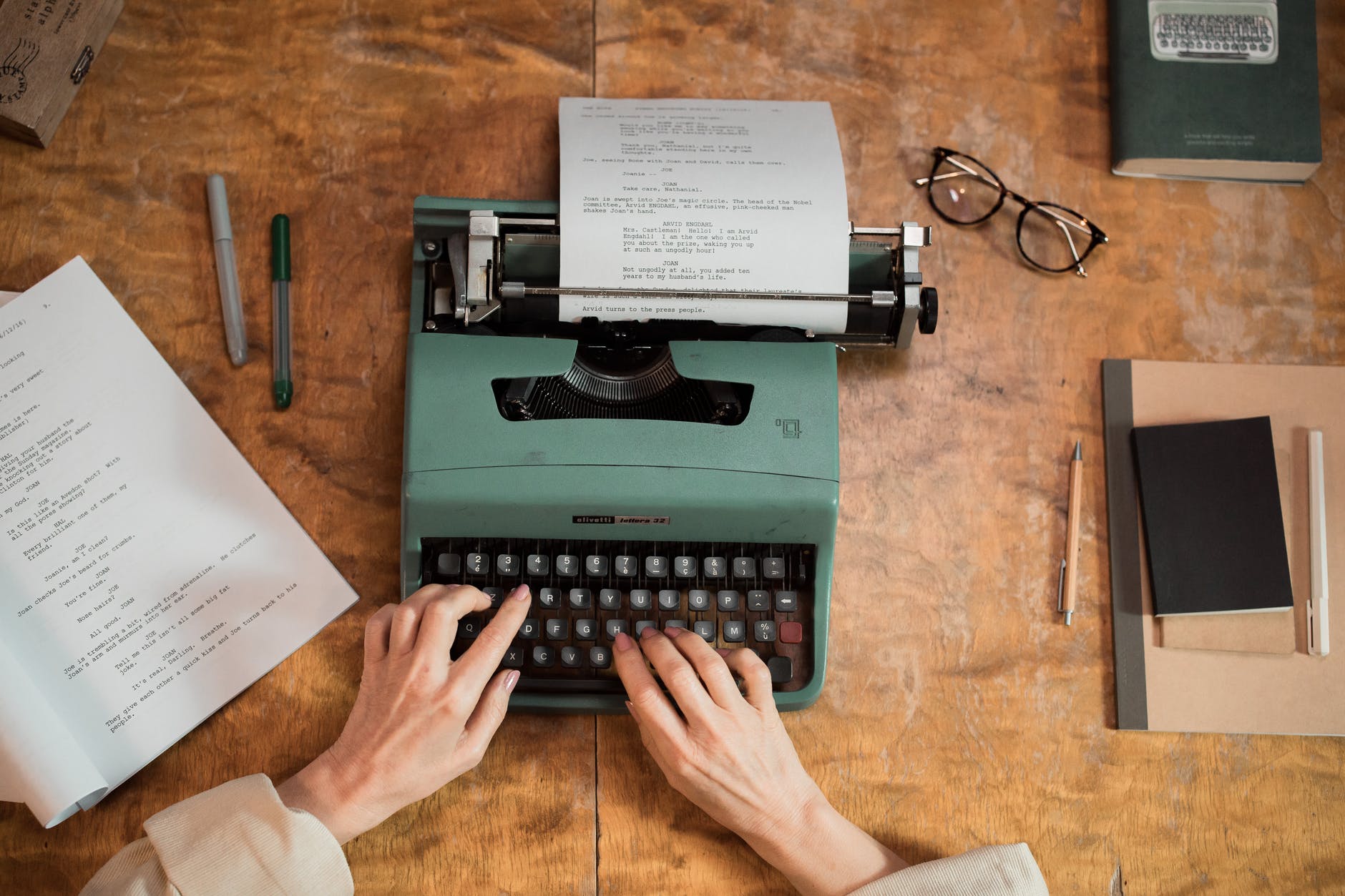
So how do you write a script with or without a budget? With his/her fingers, fortunately.
This article is quite long:
Pour commencer, nous dirons qu’il y a seulement quelques règles à connaître sur le scénario.
The basic rules of the scenario.
L’intégralité du scénario doit être écrite au présent de l’indicatif, en police standard (Courier, Arial), taille 12, au format justifié pour les descriptions. Tandis que les dialogues doivent tous être centrés et le prénom du personnage qui s’exprime doit être en lettres CAPITALE.
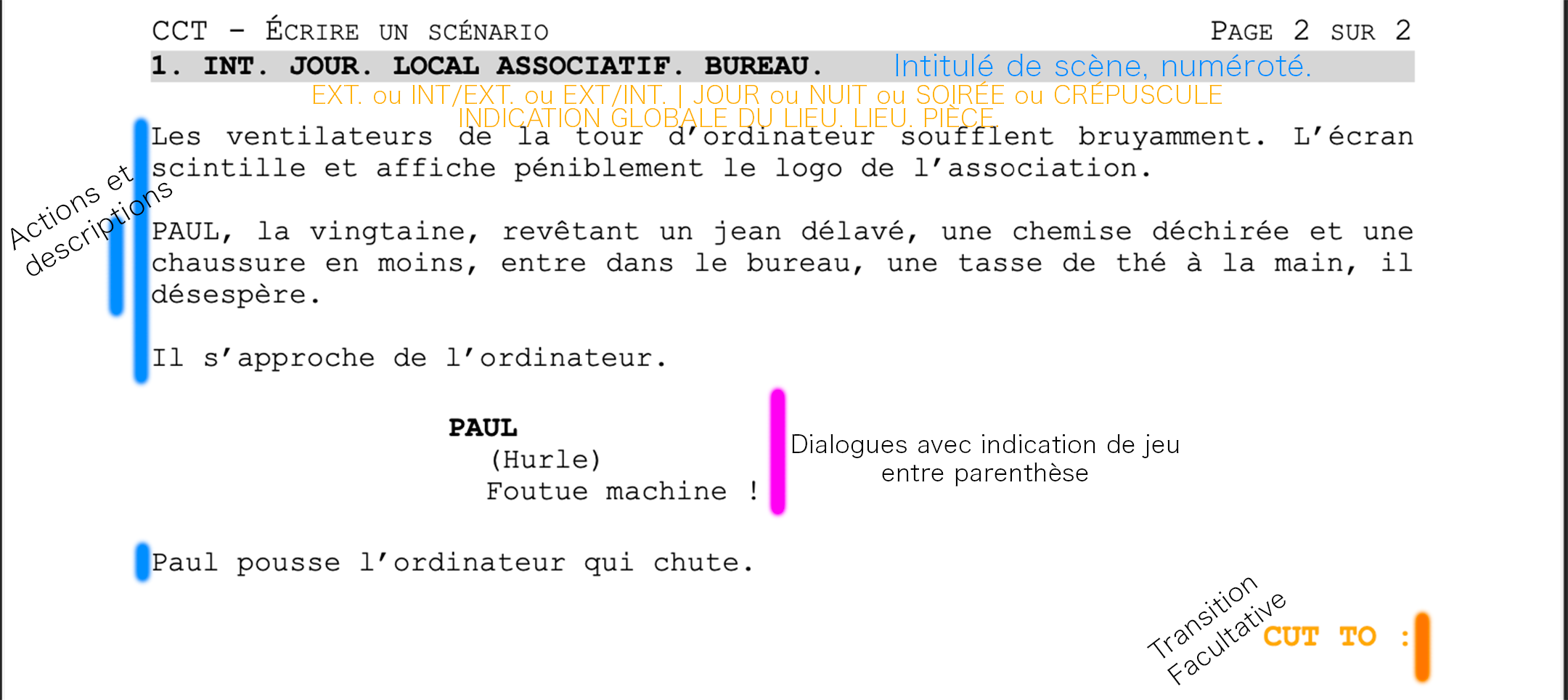
Et, c’est tout.
C’est vraiment si simple ?
Eh bien, la présentation du scénario, c’est la partie facile. Maintenant, il faut l’histoire.
The first step, generally speaking, before typing the “screenplay,” is to write a treatment. A treatment is a very long synopsis that is, in terms of length, roughly one-sixth of the dialogue-driven script. The script with dialogue is what is commonly referred to as: screenplay. For a ninety-minute film, the treatment will be fifteen pages long. For a 120-minute film, it will be twenty pages, and so on.
C’est long, c’est chiant, mais ça permet d’avoir une idée globale ainsi qu’une structure de l’histoire qui sera racontée avant de passer à la screenplay.
OK, d’accord. Comment je structure alors ?
Là, on commence à rentrer dans le dur. Il n’y a pas de recettes miracles pour structurer une histoire. Mais, d’abord, il faut déjà trouver son histoire.
How do I find my story?
The best thing to do, at least to start with, is to choose a topic that’s close to our hearts. A subject you’re familiar with, a topic you know well. That way, you avoid a whole lot of research—whose sole purpose is to make the story more believable—and it also helps you avoid writing stories that are too “predictable” or overly convoluted.
The more personal your story is, the more it resonates with the audience—and, as a result, the more original it is.
And if my life is completely ordinary, what am I supposed to do?
Eh bien, là, il faut inventer. Il sera absolument nécessaire de faire des travaux de recherche pour éviter, non seulement, de copier ce qui a été fait, mais également pour assurer une cohérence dans l’histoire racontée.
Ultimately, either you have it in you: an innate talent for writing, or you learn it. And so, you read a lot, watch a lot of movies, and nurture your imagination. There’s no other way. Creativity doesn’t just fall from the sky. It’s something you have to work on.
Next, once you have a foundation for your story, you start developing and structuring it.
La ST-euh-RUC-TURE.
I could leave this paragraph blank. There isn’t just one “structure,” but several structures. In fact, there are as many structures as there are screenwriters.
Pour être sûr et certain de ne pas partir dans tous les sens, il est primordial de connaître, tout d’abord, sa fin. La conclusion.
Si vous savez, avant même de commencer, où vous voulez aller, il sera beaucoup plus aisé de s’y rendre. C’est un conseil, pas une obligation.
What about a little structure while we're here?
The exposition: where the characters, the story, the context, and the stakes are introduced. This first section accounts for between twenty-five and thirty-five percent of the film’s total runtime. This exposition can be much shorter; there are no hard and fast rules.
- L’exposition : où les personnages, l’histoire, le contexte ainsi que les enjeux sont présentés. C’est une première partie qui représente entre vingt-cinq et trente-cinq pour cent de la durée totale du film. Cette exposition peut être bien plus courte, il n’y a pas de règle écrite.
- Obstacles, conflicts, and trials: the most important part of the film—accounting for more than fifty percent of its total runtime—where the characters develop, where they overcome (or fail to overcome) insurmountable trials, and which leads to the climax: the ultimate, culminating point of no return in the conflict, thus leading to its…
- Resolution: This is where the final conflict and its resolution take place, leading to the only logical conclusion for the hero (and his companions). The shortest part of the film.
Il s’agit là de la structure typique de toute œuvre « artistique ». Un début, un milieu et une fin.
Si cette structure est trop simpliste et que vous n’arrivez pas à écrire, alors vous pouvez adopter (ou non) la fameuse structure narrative dite du « Voyage du Héros« , mais vous pouvez aussi déstructurer complètement votre histoire. Entremêler les différentes étapes, les différents pans de votre histoire sans vous soucier de la screenplay.
Votre structure trouvée, il ne reste qu’à écrire le traitement qui, pour l’instant, n’est qu’un gros résumé – toujours au présent – de votre histoire en développement. Mais avant cela, il faut vérifier que tout est prêt pour commencer à taper.
Hein ? Qu’est-ce qu’il raconte, le monsieur ?
Vous savez désormais ce qu’est un traitement, vous savez comment trouver une histoire, vous savez comment cultiver votre imagination.
C’est excellent.
The message.
But have you pinpointed the message of your film? Its ultimate goal? The perspective you’re advocating? After all, that is the very purpose of a film. You have a vision to champion, you have a story to tell—yet is that message crystal clear even before you begin?
Is it too overshadowed, blurred, or nonexistent in the movie you're writing?
Are you certain that the perspective, structure, and narrative you've chosen are appropriate for the message(s) you want to convey?
The Characters.
Est-ce que vos personnages sont attachants ? Suscitent-ils suffisamment d’empathie afin que le spectateur puisse s’identifier à eux ?
Does the antagonist, the antihero, have a goal? Does he still have a shred of humanity? If not, do you know why? (“He's evil because he's evil” is not a valid answer here.) What motivates him?
Vous devez connaître tous vos personnages, vous devez les connaître comme s’il s’agissait de vos meilleur(e)s ami(e)s, vous savez ce qu’ils aiment, ce qu’ils détestent, leur couleur préférée, la couleur des yeux du chien de leur père, ce qui les motive, ce qui les rend plus forts, ce qui les affaiblit. Vous ne pouvez pas laisser de zone d’ombre.
If you can answer all these questions, if you convey a clear message, and if your characters have depth and a clear, distinct, and precise motivation, then—and only then—you are ready.
Can't answer some (or all) of the questions? Don't panic. Pick up a book and read it. Find a movie and watch it. From now on, try to figure out the motivations of the different characters, and look for the message and the point of view presented by the novelist-screenwriter.
Were you able to spot them in these works? Just do the same thing, but with your own movie.
Okay, I'm ready, and now?
Now you need to type out the treatment, the length of which depends on the total runtime of your film. Once this valuable document is written, you can move on to the next step.
Which is the scene-by-scene.
C’est quoi, ça, encore ?
The scene-by-scene is the intermediate step before the continuity. This is where the screenplay begins to come to life, little by little. You should already start fleshing out all the scenes, but for now, leave the dialogue out.
Enfin, pas complètement, à cette étape de l’écriture, les dialogues sont plutôt « rapportés », autrement dit, les personnages ne s’expriment pas directement, leurs paroles sont distillées succinctement dans les descriptions et actions.
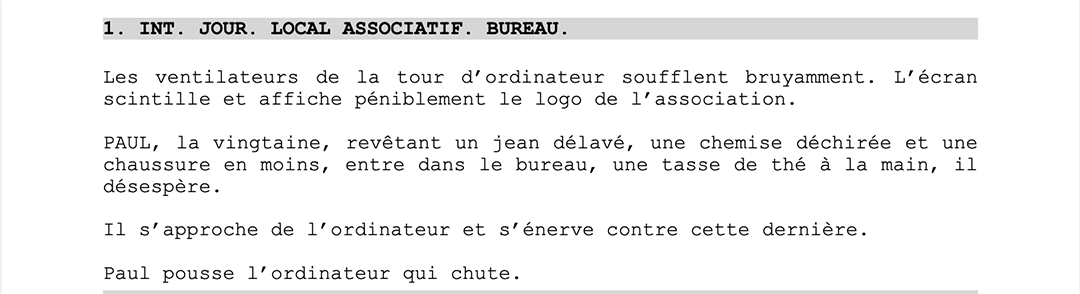
This step—which can vary in importance—already helps ensure that the structure you’ve chosen is coherent and that nothing is missing from your story. It also allows you to determine the overall length of your film and to make sure that lulls that are too long don’t weigh down your narrative.
Si vous avez répondu à toutes les questions, plus haut, que vous connaissez vos personnages, votre histoire, le point de vue que vous défendez, il ne reste qu’à taper.
C’est bon, c’est tout ?
If you’re finally satisfied with your scene-by-scene, then you can start writing the continuity and thus present your screenplay in accordance with industry standards, featuring vivid, lively characters who speak naturally.
How can I find out how long my movie is?
La règle, c’est : une page est égale à une minute de film.
But this rule varies depending on the type of screenwriter you are. Do you love long descriptions? If so, you can shave fifteen seconds off your page. Do you like long dialogues that border on monologues? Once again, you can shave ten seconds off.
Additionnez ces chiffres tout au long de votre scénario, vous avez une durée globale. En général, c’est l’un des assistants du réalisateur, ou un assistant de production qui doit chronométrer le scénario, l’estimer en fonction de son expérience. En effet, le scénariste, à moins qu’il soit aussi réalisateur et qu’il doive absolument respecter une certaine durée, se contrefiche absolument de la longueur de son scénario.
Sauf s’il est creux. Et bien évidemment, s’il manque d’action, de conflits, de buts.
J’ai fini d’écrire mon scénario, maintenant, on tourne ?
Well, no. Not yet. Right now, we’re taking a step back. We’re taking a breather. We’re watching a movie, going out, and taking a walk. We’re seeing our friends, running errands, and putting this whole situation out of our minds. We’re picking up a book—or two.
On oublie ce maudit scénario, on laisse toute l’histoire maturer dans un coin. Après une dizaine de jours, on y retourne et on passe toute l’histoire en revue. En êtes-vous toujours satisfait(e) de cette histoire ? Est-ce qu’il manque quelque chose ? Est-ce qu’il y a quelque chose en trop ? Est-ce qu’il faut réécrire ?
Vous ne savez ? Faites-vous relire par quelqu’un d’autre et attendez ses commentaires. Vous êtes satisfait(e) de votre travail ? Alors, maintenant, on passe à la suite.