Do you have an idea? A project? A story you'd like to bring to life? We can't promise to make it happen, but we can at least talk about it, and who knows? Maybe even get your story started.
Start my journey
To start your journey, nothing more simple; just contact us by email or directly from the form on this page, and an answer will be given to you. Don’t expect an answer in less than twenty-four hours; however, sometimes we’re a little drowned in our work.
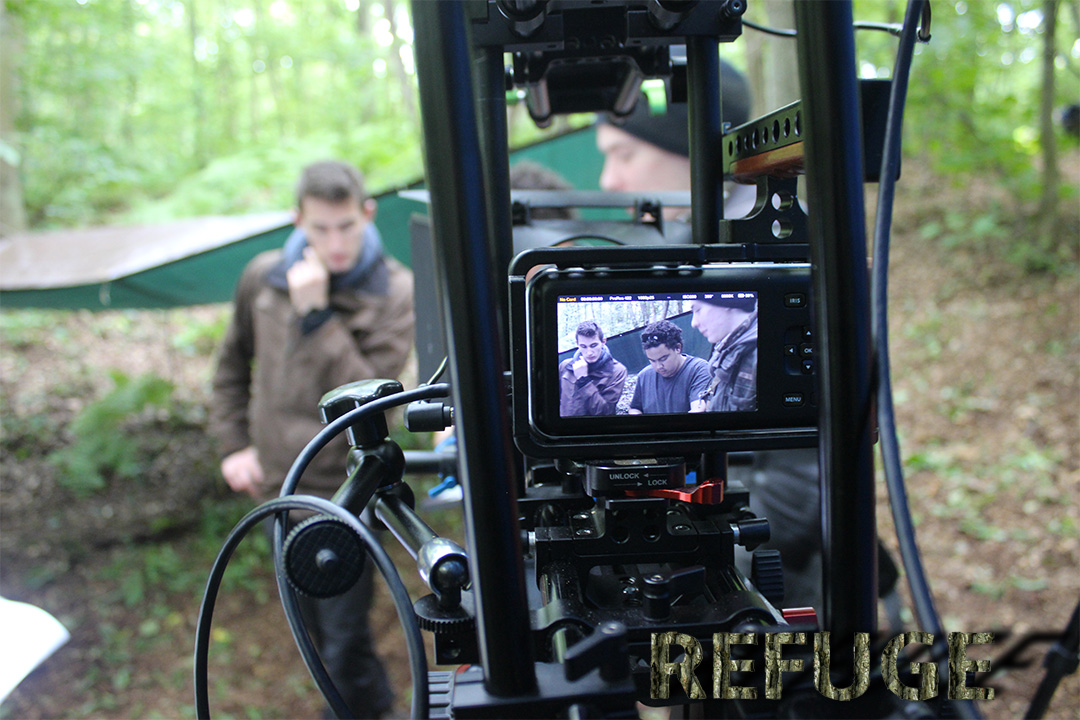
Mise en place avant le tournage de l’une des dernières scènes de REFUGE, Saison 2.
And then, we start filming?
Not necessarily.
Ce serait trop facile de vous dire que l’on va immédiatement tourner votre projet. Un projet coûte de l’argent, demande du temps. Nous ne souhaitons pas précipiter les tournages et mal préparer puis mal-tourner les projets que nous pourrions accompagner. Ça n’aurait aucun sens.
What we can do for you
An accompaniment, a proofreading of your project, the loan of equipment, contacts. This allows you to start your story, in any case, to make it happen.
Chaque projet, chaque membre, a ses spécificités, ses propres besoins. Il nous est difficile — à l’avance — de déterminer ce dont, you, specifically might need.
Start my story with CLAP! Ça Tourne!
If you are ready to start your story, or in any case, ready to make the first contact, our contact form is specifically for you.
But how much does it cost?
Difficile à dire. L’association veut être ouverte à toutes et tous. Une cotisation annuelle est due, généralement. Nous sommes bien conscient·e·s chez CLAP ! Ça Tourne ! que cela n’est pas possible pour tout le monde.
Since we cannot finance most ambitious projects, we prefer that you keep at least a part of the contribution in order to fund your project.
Photo by Reynaldo #brigworkz Brigantty on Pexels.com
C’est la grande question. Comment faire un film quand on n’a pas un rond en poche.
La réponse simple ? On évite de le faire, ça nous épargne bien des problèmes. Mais, si vous êtes là, c’est que vous avez envie de faire des films avec ou sans argent. (Surtout, sans)
So, what do we do?
Even before you start, you have to plan your film based on your budget, your ability to scrape together a little nest egg, and your ability to bring together a team that will stick with you throughout this somewhat crazy journey.
De la même façon, on pense aux décors qu’on pourra trouver et qui resteront dans le budget — dans notre cas, nonexistent —, c’est pareil pour les costumes, les accessoires et tout ce qui pourrait nécessiter une dépense, en numéraire. Il n’y a pas d’argent alors, ne créons pas de situations où celui-ci devrait être nécessaire, faisons simple.
Ouais, d’accord, mais on fait quoi, sans argent ?
Not much.
Patrick definitely has a few issues, just like us.
Je suis honnête, dans ce secteur, on ne fait rien sans argent. Pour filmer, il faut une caméra et même si on se rabat sur la caméra intégrée à son téléphone, quelqu’un a bien dû le payer, ce téléphone. C’est similaire pour le son qui est primordial. Le premier poste de dépense. On pourra toujours s’arranger avec le copain d’un pote qui est dans un groupe et qui fait de la musique, mais il faut un micro, sinon, c’est foutu.
You can always shoot a short clip without sound—typically a silent film. If you have a state-of-the-art phone, a DSLR, a mirrorless camera, or any other recent model, you can always try to make do with the built-in microphones—which I don’t recommend, but we’re on a tight budget for the purposes of this article.
Now you need a team. You could always ask two or three friends to come help out in exchange for, say, a hot meal. But who pays for the hot meal?
Au bout du compte, il a quand même fallu d’une façon ou d’une autre mettre de l’argent quelque part.
On peut tourner quelques séquences sans budget, des saynètes, des très courts-métrages pour se faire la main, c’est parfaitement possible. Mais, à moins d’avoir un millier d’amis sous la main qui reposteront vos vidéos sur YouTube, Instagram, TikTok, Twitter et Facebook, vos vidéos feront dix vues et le jeu n’en vaudra pas la chandelle.
Getting the word out about your film, promoting it, and distributing it all require an investment. You need to be able to print posters and put them up everywhere you can; you need to promote your trailer with sponsored links—or be content to remain buried in the depths of YouTube, ranked somewhere between cat videos and Minecraft clips.
C’est le jeu.
Bob is deep in thought, just like you are right now.
Bon, alors comment fait-on avec un peu, d’argent ?
Puisque c’est ça la véritable question. Il ne suffit pas de to just grab something that can film to make a movie.
En effet, il faudra une petite mise de départ et composer son film autour. Il faudra trouver des premiers soutiens, des premiers contributeurs qui accepteront de vous fournir un peu de matériel ou bien un peu d’argent. Ne serait-ce que pour la nourriture lors du tournage (poste de dépense an essential expense) and to fund the promotion of your project.
Parce que pour faire un bon film, il n’y a pas besoin de millions d’euros, seulement d’une bonne histoire qui fits within the initial budget. Peu de lieux, sinon beaucoup d’extérieurs. Assurez-vous d’obtenir les autorisations de tournage nécessaires pour tourner en plein air.
Peu d’acteurs, sinon… là, il vous faut un miracle.
La recette, simple, c’est :
A good story, in few places, with four actorsmaximum, on a very tight schedule.
Utilisez l’argent qui vous reste pour fund festival entries or promote your film.
L’autre astuce ? C’est d’écrire des articles pompeux et de promouvoir son film dedans, un peu comme ici. Vous pouvez retrouver notre très court-métrage VALENTIN Produced with a budgetfor equipment and editing software
Cet article est le premier d’une longue série consacrée à la réalisation de A à Z d’un film-websérie-projet audiovisuel.
Valentin, our very short film about sexual violence.
Valentin, a very low-budget short film directed by Paul AGAT and Lorys BELIA.
We use cookies to optimize our website and offer more features.
Functional
Always active
Technical storage or access is strictly necessary for the legitimate interest of enabling the use of a specific service explicitly requested by the subscriber or user, or for the sole purpose of transmitting a communication over an electronic communications network.
Preferences
Technical storage or access is necessary for the legitimate interest of storing preferences that are not requested by the subscriber or user.
Statistics
Storage or technical access used exclusively for statistical purposes.Storage or technical access used exclusively for anonymous statistical purposes. Absent a court order, voluntary cooperation from your internet service provider, or additional records from a third party, information stored or retrieved for this purpose alone generally cannot be used to identify you.
Marketing
Technical storage or access is necessary to create user profiles for the purpose of sending advertisements, or to track the user across a website or multiple websites with similar marketing objectives.